Animations
This page collects the different sub-pages on my site devoted to visualization and animations of our numerical simulations. Click on any of the topics below to browse the different animations and get additional information about the simulations.
For a simple archive of all the movies below (and others), go to http://www.tapir.caltech.edu/~phopkins/movies/
Cosmological Simulations: Feedback Changes Everything
Movies from the FIRE (Feedback In Realistic Environments) Project
These movies show simulations of individual galaxies forming, starting at a time when the Universe was just a few million years old (redshift of 100). They follow the region that will become a single galaxy by the present time, tracing the evolution of dark matter and gas, which eventually turns into stars. Those stars then 'light up' the medium around them with both radiation and supernova explosions.
Cosmological Simulations: Flying Through a Milky-Way Like Galaxy
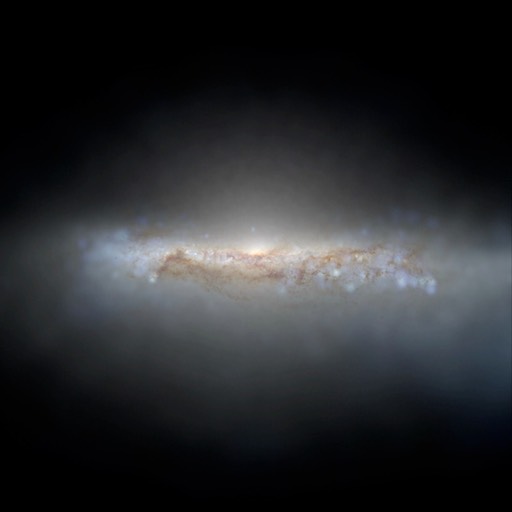
Just like the movies here, these movies are from the same set of simulations of individual galaxies forming, starting at a time when the Universe was just a few million years old (redshift of 100). These movies "fly through" the galaxy from the outskirts to the center and back again, showing different observable quantities: mock Hubble images, X-rays, observational tracers of star formation, and more.
Latte
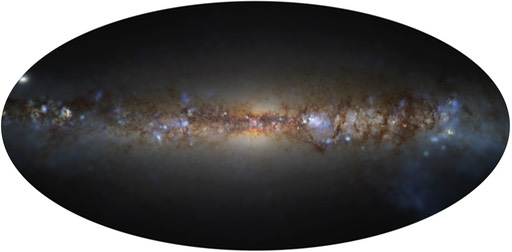
A video explaining the breakthroughs and new physics in our "Latte" simulations — the highest-resolution simulations of a Milky Way-like galaxy ever run to the present day, presented in Wetzel et al. 2016 (arXiv:1602.05957).
Feedback from Massive Stars: Movies
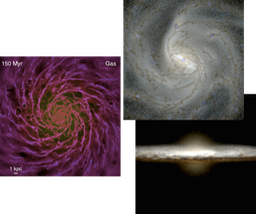
These movies show simulations of isolated disk galaxies under the influence of "feedback" from massive, young stars. In the absence of such feedback, the gas in the galaxies would cool rapidly, collapsing into dense 'nuggets' that form stars at a rate 100 times faster than observed. These movies show how radiation pressure, stellar winds, photo-ionization, and supernovae together regulate star formation.
Galaxy Mergers: Now with Feedback from Massive Stars
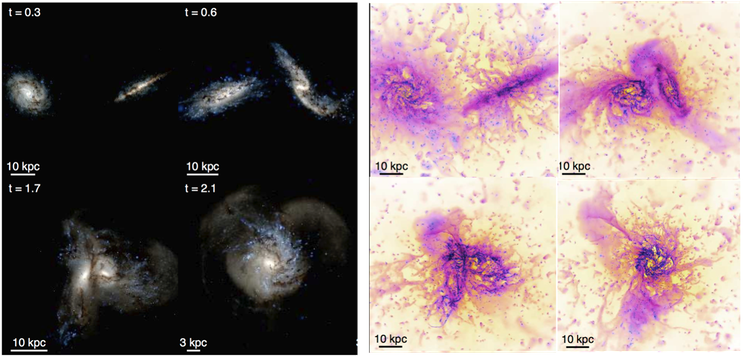
These movies show what happens when the same disk galaxies collide in major mergers. Feedback from massive stars drives powerful super-winds during the collision and final coalescence, dramatically shaping the merger remnant. Movies include gas-rich starburst mergers, Milky Way-mass mergers, dwarf galaxy mergers, and high-redshift starbursts.

AGN Fueling: Movies
In a recent series of papers (the first available at arXiv:2309.13115) we present the first-ever cosmological simulations that follow how material gets "all the way down" from cosmological scales to fuel and power super-massive black holes and quasars. Combining the FIRE and STARFORGE physics into a single code, we follow gas from millions of light-years away into the galaxy, through its nucleus, and all the way down to form an accretion disk around the central black hole — with disk properties wildly different from the 50-year-old "textbook" model. Movies of the new simulations, plus our older "previous-generation" zoom-in merger work for comparison.
Dust and Gas in Astrophysical Systems
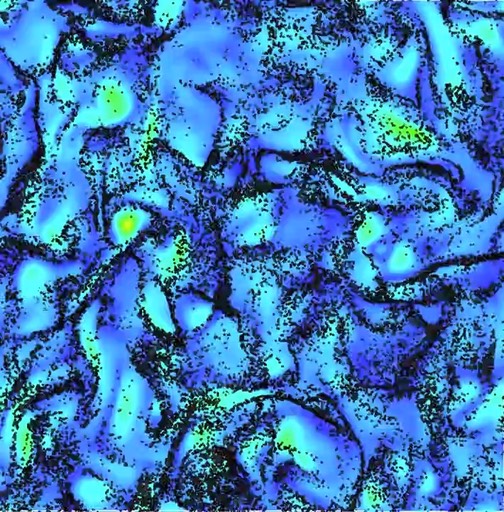
Dust is everywhere in astrophysics — literally! It contains most of the heavy elements, forms the building blocks of planets, and dramatically alters our view of everything in the Universe. We recently discovered a new super-class of instabilities that manifest in a myriad of different ways, whenever dust moves through gas. These movies illustrate the remarkable richness of this new physics.
Astrophysical Fluid Dynamics
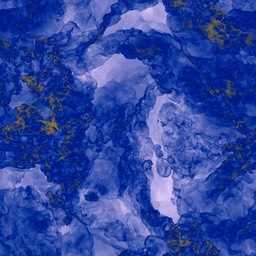
Our group studies a wide variety of astrophysical fluid dynamics and plasma physics. See the GIZMO page for more details. These movies illustrate basic problems: driven turbulence, Kelvin-Helmholtz instabilities (comparing numerical methods and plasma physics), Rayleigh-Taylor instabilities, 2D turbulence and inverse cascades, and evolving Keplerian disks.
Voyage of Time Animations
These animations were pre-renders for the cinematic release of Voyage of Time. They include two galaxies colliding, looking "down the barrel" at the furnace of galaxies, and a Milky Way fly-around. See http://voyageoftime.imax.com/#videos for more.
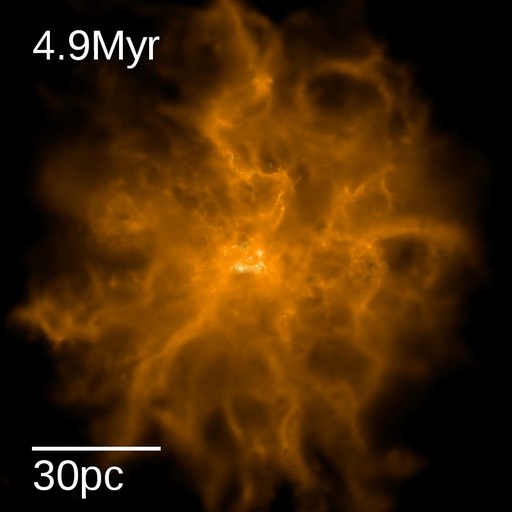
Stars, Star Clusters & Molecular Clouds
Many members of our group study the formation of individual stars, star clusters, molecular clouds, and structures within the interstellar medium. These movies were put together by Mike Grudic and David Guszejnov, studying the origin of stellar masses, the formation and destruction of molecular clouds, their collapse into individual stars and star clusters, and the dynamical evolution of those clusters after they form.
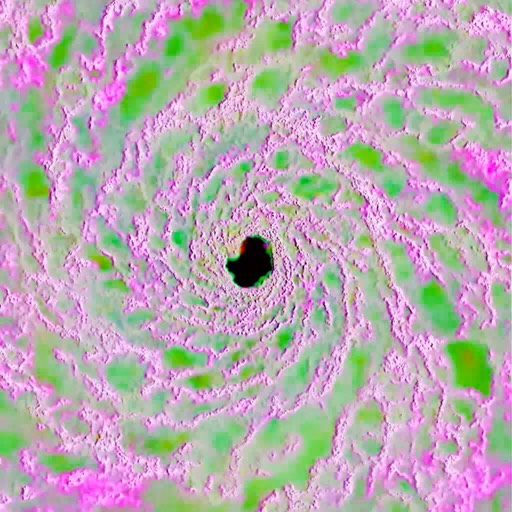
AGN Driving Outflows in Galactic Nuclei
More recent simulations of ours following fueling and feedback of super-massive black holes, in simulations with a detailed treatment of the physics of the interstellar medium (ISM) and star formation. Also see the "AGN Fueling" movies here.
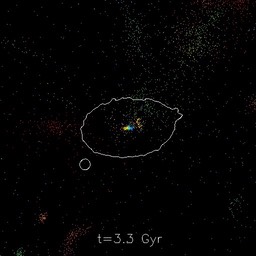
Additional FIRE Galaxy Visualizations: the CGM/IGM and Kinematics
Additional FIRE visualizations made by our collaborators, including: kinematics of misaligned disks, IGM gas densities and temperatures, gas flows in the circum-galactic medium, cosmic rays propagating into the CGM, circum-galactic absorbers and phases with and without cosmic rays, and outflows of heavy elements.

Gallery of (Simulated) Galaxies
A series of mock Hubble Space Telescope images of our FIRE simulated galaxies at the present day. Every galaxy shown here is a simulation run from cosmological initial conditions — essentially starting with the cosmic microwave background and basic physical equations, and evolving to present day.
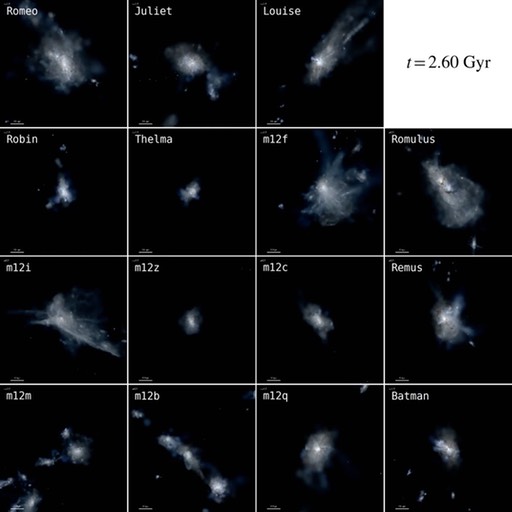
A Gallery of Milky Way & Andromeda-like Systems
As part of the FIRE project, we have simulated a large number of galaxies that resemble the Milky Way or Andromeda, including some "Local Group" systems which include both, together, like our own neighborhood. Shea Garrison-Kimmel has compiled a large number of movies of these different systems, side-by-side.
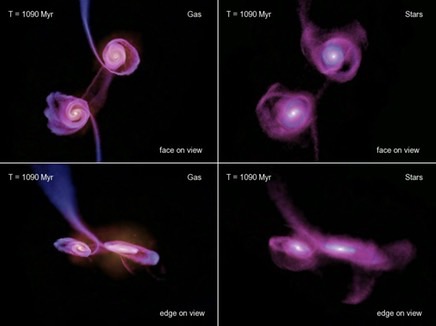
Galaxy Mergers: Movies
These movies show typical simulations of major galaxy mergers. In the mergers, two Milky Way-like disk galaxies with a 2:1 mass ratio are placed in an initial parabolic orbit. The disks are constructed in equilibrium with properties corresponding to observed disk galaxies, and include stellar and gas disks, central spheroidal bulges, and black holes, within a dark matter halo.

Additional High-Quality Images
Additional images chosen from our published papers. I frequently get asked if people can use these in talks: yes, but please credit the actual publication or collaboration!