A reorientable map from the cube to a frustum. More...
#include <Frustum.hpp>
Public Member Functions | |
| Frustum (const std::array< std::array< double, 2 >, 4 > &face_vertices, double lower_bound, double upper_bound, OrientationMap< 3 > orientation_of_frustum, bool with_equiangular_map=false, double projective_scale_factor=1.0, bool auto_projective_scale_factor=false) noexcept | |
| Frustum (Frustum &&)=default | |
| Frustum (const Frustum &)=default | |
| Frustum & | operator= (const Frustum &)=default |
| Frustum & | operator= (Frustum &&)=default |
| template<typename T > | |
| std::array< tt::remove_cvref_wrap_t< T >, 3 > | operator() (const std::array< T, 3 > &source_coords) const noexcept |
| std::optional< std::array< double, 3 > > | inverse (const std::array< double, 3 > &target_coords) const noexcept |
Returns std::nullopt if \(z\) is at or beyond the \(z\)-coordinate of the apex of the pyramid, tetrahedron, or triangular prism that is formed by extending the Frustum (for a \(z\)-oriented Frustum). The inverse function is only callable with doubles because the inverse might fail if called for a point out of range, and it is unclear what should happen if the inverse were to succeed for some points in a DataVector but fail for other points. | |
| template<typename T > | |
| tnsr::Ij< tt::remove_cvref_wrap_t< T >, 3, Frame::NoFrame > | jacobian (const std::array< T, 3 > &source_coords) const noexcept |
| template<typename T > | |
| tnsr::Ij< tt::remove_cvref_wrap_t< T >, 3, Frame::NoFrame > | inv_jacobian (const std::array< T, 3 > &source_coords) const noexcept |
| void | pup (PUP::er &p) noexcept |
| bool | is_identity () const noexcept |
Static Public Attributes | |
| static constexpr size_t | dim = 3 |
Friends | |
| bool | operator== (const Frustum &lhs, const Frustum &rhs) noexcept |
Detailed Description
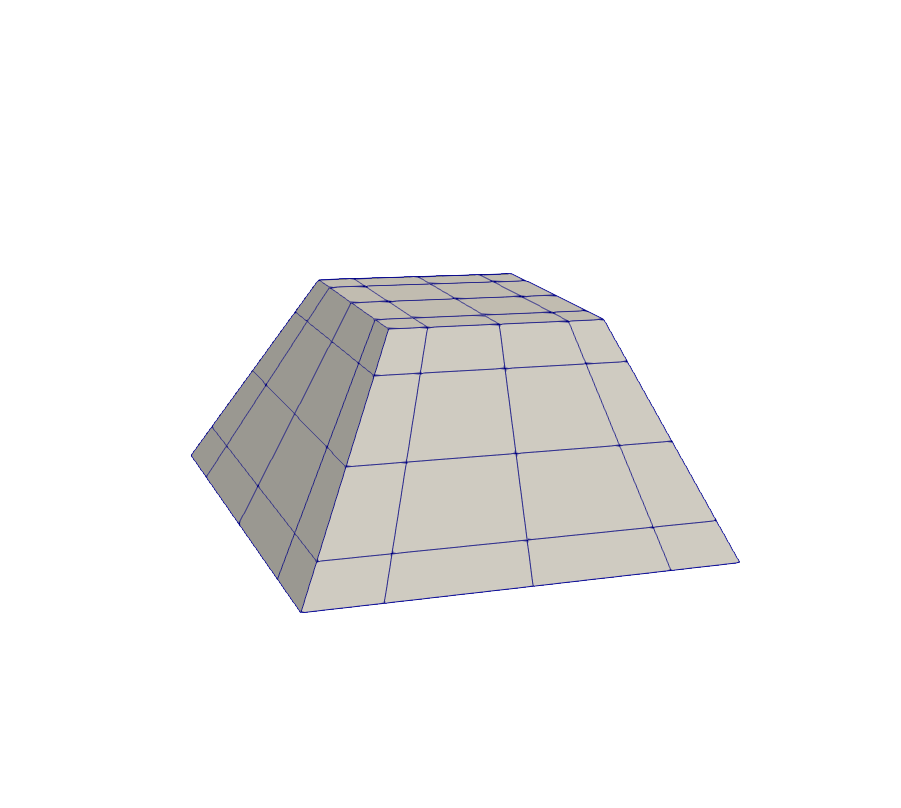
A reorientable map from the cube to a frustum.
Description and Specifiable Parameters
A map from the logical cube to the volume determined by interpolating between two parallel rectangles each perpendicular to the \(z\)-axis. A Frustum map \(\vec{x}(\xi,\eta,\zeta)\) is determined by specifying two heights \(z_1 = \) lower_bound and \(z_2 = \) upper_bound for the positions of the rectangular bases of the frustum along the \(z-\)axis, and the sizes of the rectangles are determined by the eight values passed to face_vertices:
\begin{align*} &\textrm{lower x upper base} : x^{+\zeta}_{-\xi,-\eta} = x(-1,-1,1)\\ &\textrm{lower x lower base} : x^{-\zeta}_{-\xi,-\eta} = x(-1,-1,-1)\\ &\textrm{upper x upper base} : x^{+\zeta}_{+\xi,+\eta} = x(1,1,1)\\ &\textrm{upper x lower base} : x^{-\zeta}_{+\xi,+\eta} = x(1,1,-1)\\ &\textrm{lower y upper base} : y^{+\zeta}_{-\xi,-\eta} = y(-1,-1,1)\\ &\textrm{lower y lower base} : y^{-\zeta}_{-\xi,-\eta} = y(-1,-1,-1)\\ &\textrm{upper y upper base} : y^{+\zeta}_{+\xi,+\eta} = y(1,1,1)\\ &\textrm{upper y lower base} : y^{-\zeta}_{+\xi,+\eta} = y(1,1,-1)\end{align*}
- Note
- As an example, consider a frustum along the z-axis, with the lower base starting at (x,y) = (-2.0,3.0) and extending to (2.0,5.0), and with the upper base extending from (0.0,1.0) to (1.0,3.0). The corresponding value for
face_verticesis{{{{-2.0,3.0}}, {{2.0,5.0}}, {{0.0,1.0}}, {{1.0,3.0}}}}.
In the case where the two rectangles are geometrically similar, the volume formed is a geometric frustum. However, this coordinate map generalizes to rectangles which need not be similar. The user may reorient the frustum by passing an OrientationMap to the constructor. If with_equiangular_map is true, then this coordinate map applies a tangent function mapping to the logical \(\xi\) and \(\eta\) coordinates. We then refer to the generalized logical coordinates as \(\Xi\) and \(\mathrm{H}\). If projective_scale_factor is set to a quantity other than unity, then this coordinate map applies a rational function mapping to the logical \(\zeta\) coordinate. This generalized logical coordinate is referred to as \(\mathrm{Z}\). If auto_projective_scale_factor is true, the user-specified projective_scale_factor is ignored and an appropriate value for projective_scale_factor is computed based on the values passed to face_vertices. See the page on redistributing gridpoints to see more detailed information on equiangular variables and projective scaling.
Coordinate Map and Jacobian
In terms of the face_vertices variables, we define the following auxiliary variables:
\begin{align*}\Sigma^x &= \frac{1}{4}(x^{+\zeta}_{-\xi,-\eta} + x^{+\zeta}_{+\xi,+\eta} + x^{-\zeta}_{-\xi,-\eta} + x^{-\zeta}_{+\xi,+\eta}) \\ \Delta^x_{\zeta} &= \frac{1}{4}(x^{+\zeta}_{-\xi,-\eta} + x^{+\zeta}_{+\xi,+\eta} - x^{-\zeta}_{-\xi,-\eta} - x^{-\zeta}_{+\xi,+\eta}) \\ \Delta^x_{\xi} &= \frac{1}{4}(x^{+\zeta}_{+\xi,+\eta} - x^{+\zeta}_{-\xi,-\eta} + x^{-\zeta}_{+\xi,+\eta} - x^{-\zeta}_{-\xi,-\eta}) \\ \Delta^x_{\xi\zeta} &= \frac{1}{4}(x^{+\zeta}_{+\xi,+\eta} - x^{+\zeta}_{-\xi,-\eta} - x^{-\zeta}_{+\xi,+\eta} + x^{-\zeta}_{-\xi,-\eta}) \\ \Sigma^y &= \frac{1}{4}(y^{+\zeta}_{-\xi,-\eta} + y^{+\zeta}_{+\xi,+\eta} + y^{-\zeta}_{-\xi,-\eta} + y^{-\zeta}_{+\xi,+\eta}) \\ \Delta^y_{\zeta} &= \frac{1}{4}(y^{+\zeta}_{-\xi,-\eta} + y^{+\zeta}_{+\xi,+\eta} - y^{-\zeta}_{-\xi,-\eta} - y^{-\zeta}_{+\xi,+\eta}) \\ \Delta^y_{\eta} &= \frac{1}{4}(y^{+\zeta}_{+\xi,+\eta} - y^{+\zeta}_{-\xi,-\eta} + y^{-\zeta}_{+\xi,+\eta} - y^{-\zeta}_{-\xi,-\eta}) \\ \Delta^y_{\eta\zeta} &= \frac{1}{4}(y^{+\zeta}_{+\xi,+\eta} - y^{+\zeta}_{-\xi,-\eta} - y^{-\zeta}_{+\xi,+\eta} + y^{-\zeta}_{-\xi,-\eta}) \\ \Sigma^z &= \frac{z_1 + z_2}{2}\\ \Delta^z &= \frac{z_2 - z_1}{2} \end{align*}
The full map is then given by:
\[\vec{x}(\xi,\eta,\zeta) = \begin{bmatrix} \Sigma^x + \Delta^x_{\xi}\Xi + (\Delta^x_{\zeta} + \Delta^x_{\xi\zeta}\Xi)\mathrm{Z}\\ \Sigma^y + \Delta^y_{\eta}\mathrm{H} + (\Delta^y_{\zeta} + \Delta^y_{\eta\zeta}\mathrm{H})\mathrm{Z}\\ \Sigma^z + \Delta^z\mathrm{Z}\\ \end{bmatrix}\]
With Jacobian:
\[J = \begin{bmatrix} (\Delta^x_{\xi} + \Delta^x_{\xi\zeta}\mathrm{Z})\Xi' & 0 & (\Delta^x_{\zeta}+ \Delta^x_{\xi\zeta}\Xi)\mathrm{Z}' \\ 0 & (\Delta^y_{\eta} + \Delta^y_{\eta\zeta}\mathrm{Z})\mathrm{H}' & (\Delta^y_{\zeta} + \Delta^y_{\eta\zeta}\mathrm{H})\mathrm{Z}'\\ 0 & 0 & \Delta^z\mathrm{Z}' \\ \end{bmatrix} \]
Suggested values for the projective scale factor
- Note
- This section assumes familiarity with projective scaling as discussed on the page on redistributing gridpoints.
When constructing a Frustum map, it is not immediately obvious what value of \(w_{\delta}\) to use in the projective map; here we present a choice of \(w_{\delta}\) that will produce minimal grid distortion. We cover two cases: the first is the special case in which the two rectangular Frustum bases are related by a simple scale factor; the second is the general case.
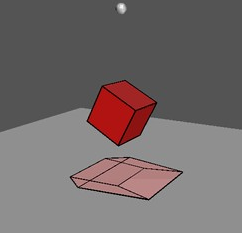
As seen in Cervone's Cubes and Hypercubes Rotating, there is a special case in which the inverse projection of a trapezoid is not another trapezoid, but a rectangle where the bases are congruent. Most often one will want to use the special value of \(w_{\delta}\) where this occurs. This value of \(w_{\delta}\) corresponds to the projective transformation mapping a rectangular prism in an ambient 4D space with congruent faces at \(w=1\) and \(w=w_{\delta}\) to the frustum in the plane \(w=1\):
\[w_{\delta} = \frac{L_1}{L_2}\]
where \(\frac{L_1}{L_2}\) is the ratio between any pair of corresponding side lengths of the \(z_1\) and \(z_2\)-bases of the frustum, respectively.
For the general case one will want to use the value:
\[w_{\delta} = \frac{\sqrt{(x^{-\zeta}_{+\xi,+\eta} - x^{-\zeta}_{-\xi,+\eta}) (y^{-\zeta}_{+\xi,+\eta} - y^{-\zeta}_{+\xi,-\eta})}} {\sqrt{(x^{+\zeta}_{+\xi,+\eta} - x^{+\zeta}_{-\xi,+\eta}) (y^{+\zeta}_{+\xi,+\eta} - y^{+\zeta}_{+\xi,-\eta})}}\]
This is the value for \(w_{\delta}\) used by this CoordinateMap when auto_projective_scale_factor is true.